How we choose reference points
We favour primary standards bodies, public safety guidance, established research institutions and technical documentation. The Food and Agriculture Organization of the United Nations offers agricultural context; research institutions such as Wageningen University & Research, Harper Adams University and the University of Lincoln help readers locate relevant technical work.
These organizations are not presented as partners or endorsers. A reference to research does not validate an unrelated product. A reference to a standard does not establish that a farm installation complies with it.
What we keep separate
Observation and inference
What a sensor measured is not necessarily the cause a model suggests.
Planning and protection
A scheduler’s allocation is not a substitute for validated machine protective functions.
Completion and usefulness
Distance travelled does not establish that the returned evidence can support a decision.
Standards are signposts, not shortcuts
ISO 11783, ISO 18497 and ISO 25119 help frame different machinery communication and safety discussions. Readers should confirm applicable parts, editions and scope with qualified specialists. Summaries here are deliberately not implementation instructions.
What we do not claim
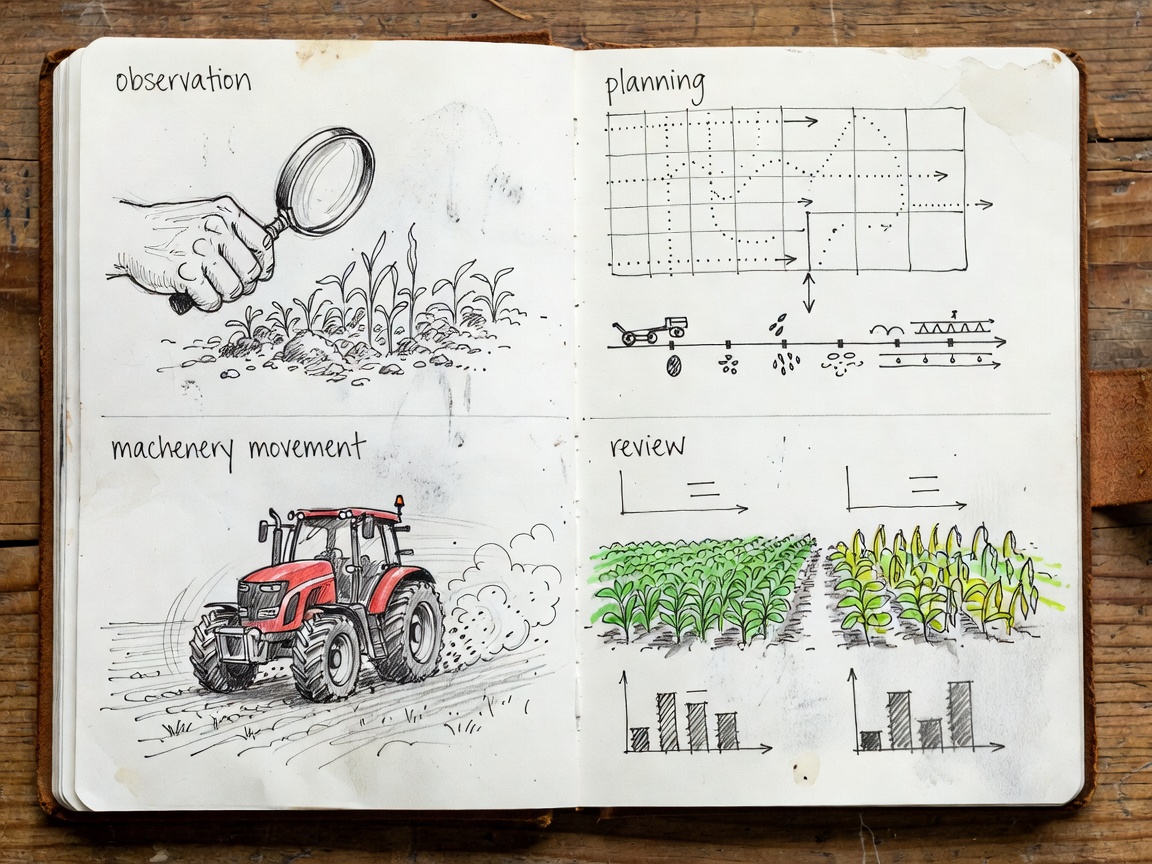
We do not promise yield improvements, endorse a universal supervisor-to-machine ratio or recommend bypassing manufacturer limits. Illustrations explain relationships; they are not surveyed field plans, machine diagrams or validated separation distances.
Corrections and field questions
If a term is unclear or an interface description appears incomplete, send the page address, the specific passage and a public source where possible. Do not include confidential product documentation without permission. We assess corrections against the evidence available and do not guarantee a publication or reply date.
Further context: FAO, University of Lincoln and ISO.